Why Scientists Are Calling HSQ E-Beam Resist the Secret Weapon of Advanced Semiconductor Manufacturing?
Aug 17, 2026

HSQ e-beam resist is a liquid, silicon-based chemical used to make extremely small patterns on computer chips. This material is also known as Hydrogen Silsesquioxane. When a beam of electrons hits this liquid, the chemical hardens and turns into a tough, glass-like layer of silicon dioxide. This clean change makes it the best choice for drawing incredibly tiny shapes, even down to sizes smaller than 10 nanometres.
Hsq Hydrogen Silsesquioxane Resist is a special liquid chemical used to build tiny electronic parts. The material starts as a liquid dissolved in a solvent. When you spin this liquid onto a flat surface, it spreads out to form a very smooth, even, and thin layer that is ready for printing.
This material reacts strongly to a beam of electrons. When the electron beam hits the liquid layer, it breaks the chemical bonds inside the material. This causes the tiny parts of the liquid to lock together and freeze in place.
This change turns the hit areas into a hard glass, while the untouched areas stay soft. When you wash the surface with a developer liquid, the soft parts wash away quickly. This leaves behind a highly detailed, hard pattern. This pattern acts as a strong shield, helping engineers carve perfect, tiny shapes into silicon pieces.
Today, computer chips must get smaller and smaller to become faster and save power. Standard plastic-based materials often fail when shapes get smaller than 10 nanometers. These older materials can swell, bend, or completely fall over when they get wet during the washing step.
This is why HSQ e-beam resist is a huge help. Because it is made of silicon instead of plastic, it stays strong and stiff even at tiny sizes. Its tiny parts allow it to form perfectly straight, clean lines without the rough edges found in older materials.
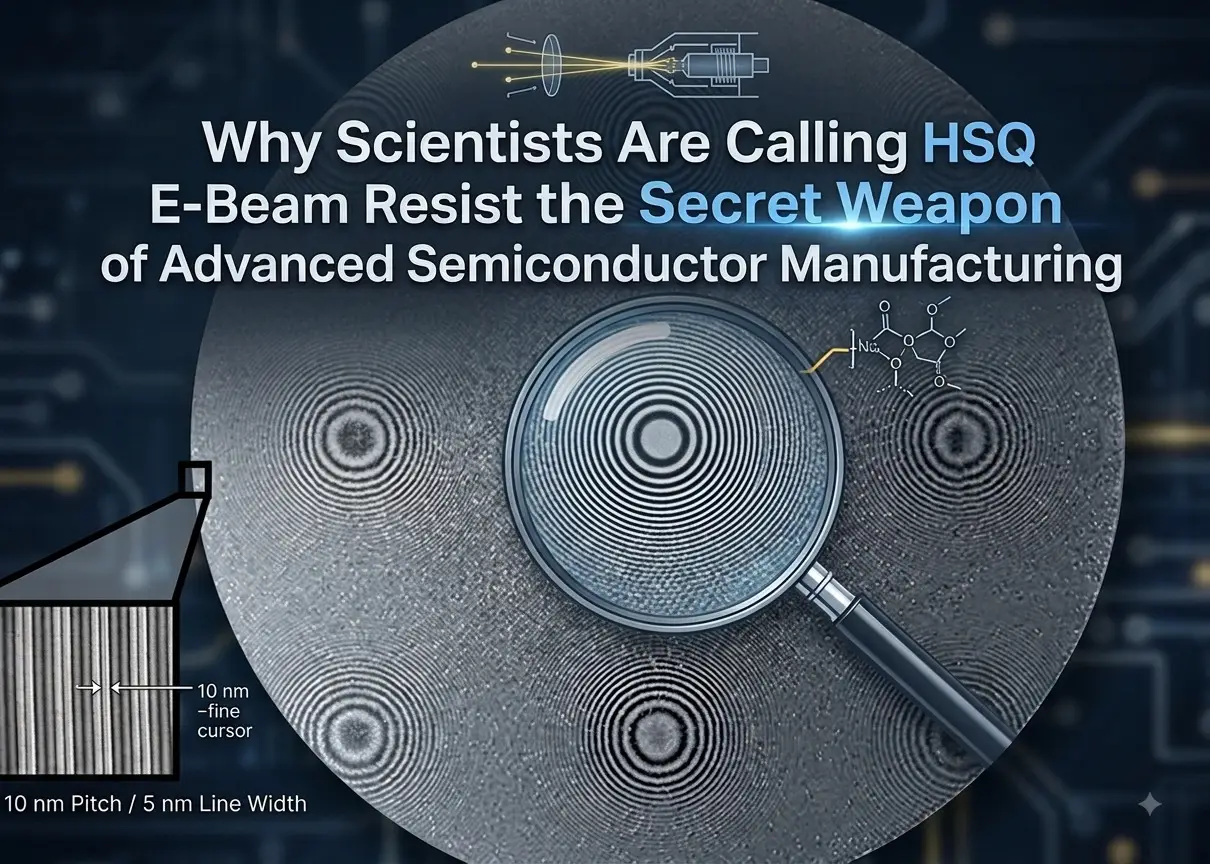
Tests from the National Nanotechnology Coordinated Infrastructure (NNCI) show that HSQ e-beam resist can easily make lines as small as 6 nanometers. It can also leave gaps of only 20 nanometers between these tiny lines. This great control makes it the top choice for building next-generation computer parts, tiny glass lenses, and new sensors.
Using Hsq Hydrogen Silsesquioxane Resist successfully requires a clean room and careful steps. Because the chemical can change with heat, wet air, and age, you must do every step the same way every time to avoid wasting materials.
A study by Yale University shows that heating the material is a key step to get the best results. When you bake the coated plate at 120 degrees Celsius for two minutes, you help the chemical stick tightly to the surface. This simple step keeps the tiny glass lines from peeling off when you wash them.
Here is a simple, structured workflow for processing this material:
Spin Coating: Spin the liquid onto a clean plate to get the exact thickness you need, from 25 to 850 nanometers.
Baking: Bake the plate at 120 degrees Celsius for two minutes to dry the liquid and help it stick tightly.
Exposure: Use a beam of electrons to draw your exact pattern onto the coated plate.
Development: Use a special wash liquid to dissolve and clean away the soft, unhit areas.
Rinsing and Drying: Rinse the plate with clean water to stop the wash, then dry it with clean air.
At DisChem, we know that getting the same results every time is key for your work. That is why we make H-SiQ, a clean, high-quality liquid designed to replace your old brand instantly.
Test data from Yale University shows that DisChem H-SiQ gives you the same sharp lines, smooth edges, and strong shield as older brands. It works perfectly with your current tools without forcing you to buy new machines or change your settings.
We ship our chemicals in cold boxes so they do not age or go bad on the way. We also back our product with a full shelf-life guarantee. Whether you run a college lab or a large chip factory, DisChem gives you the reliable chemicals you need to reduce waste, lower costs, and get more working parts.
In the field of tiny science, there is no room for mistakes. Choosing the right HSQ e-beam resist can make the difference between a failed test and a major success. With DisChem’s clean H-SiQ, you get a reliable liquid that gives you the exact, tiny shapes your work demands. By choosing us, you can build new, tiny things with confidence while keeping your work simple and reliable.
Are you ready to improve your microchip manufacturing yield and achieve cleaner, sharper nanostructures? Contact our chemical experts today to discuss your specific lithography requirements, request a custom formulation, or place an order.
1. What is the shelf life of HSQ e-beam resist?
Our HSQ e-beam resist has a full guarantee. It stays fresh for up to nine months in a standard lab fridge. If you store the chemical in a deep freezer, you can stop the aging process and keep it ready to use for a very long time.
2. What developer should I use with Hsq Hydrogen Silsesquioxane Resist?
You can wash Hsq Hydrogen Silsesquioxane Resist using standard liquids. The most common choices are TMAH solutions or standard sodium mixes. These liquids easily wash away the soft parts, leaving behind sharp, glass-like patterns with tall, clean walls.
3. How does HSQ compare to organic photoresists?
Unlike plastic-based liquids, HSQ turns into pure glass when hit by electrons. This glass structure keeps the tiny patterns from swelling or falling over at tiny sizes. It also stands up better to harsh gases, which saves you steps and time.
4. What is the best storage temperature for HSQ resist?
You should store this chemical in a lab fridge between 4 and 10 degrees Celsius. Keeping it cold stops the liquid from forming clumps or getting hard too soon. For long-term storage, keeping it in a deep freezer will pause the aging process completely.
5. Can I adjust the film thickness of DisChem H-SiQ?
Yes. You can control how thick the layer is by changing how fast you spin it or by choosing different mixes. DisChem offers custom blends from 1 percent to 20 percent strength. This helps you get exact layer thicknesses from 25 to 850 nanometers.